Richard Mille’s Micron Problem: AI, CNC, and the Materials That Refuse to Behave
Richard Mille’s Micron Problem: AI, CNC, and the Materials That Refuse to Behave
Richard Mille machines Carbon TPT, sapphire, and titanium to single-micron tolerances. Here is where AI fits into CNC machining optimization and quality control for luxury watch components.
The manufacture where materials set the rules
Inside Richard Mille’s Les Breuleux facility in the Swiss Jura, the sound is not of watchmakers at benches. It is the sound of 15 CNC machines running around the clock, cutting titanium, Carbon TPT, carbon nano fibre, and Titacarb into components that will eventually become watches selling for six figures and beyond . The brand makes roughly 80% of its parts in-house, and in 2024 more than half of its 5,900 watches were produced in this building .
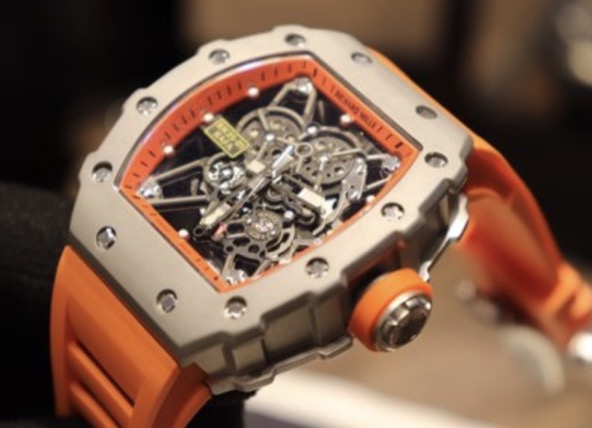
Richard Mille’s engineering identity is inseparable from its materials. Carbon TPT, a layered composite developed with North Thin Ply Technology, and Gold Quartz TPT, a quartz-fibre composite, are not decorative finishes. They are structural materials with anisotropic behaviour: their mechanical properties change depending on the direction of the fibre layup. Machining them is not like cutting brass or steel. It is closer to machining a aerospace laminate that happens to be destined for a wrist.
This is the context in which AI-assisted CNC machining optimization for luxury watch cases stops being an abstract trend and becomes a production necessity.
Why single-micron tolerances change the AI calculus
Richard Mille’s case tolerances are measured in microns—often within one to a few microns, a range more commonly associated with complex movement components than with watch exteriors . For sapphire cases, the finished tolerances can sit within ten microns, and coordinate-measuring machines check hundreds of points on a surface to verify geometry . Carbon TPT and sapphire also resist traditional finishing and gem-setting methods entirely; the brand relies on CNC milling and laser work calibrated to single-micron margins to create cavities and structures that behave more like aerospace engineering than jewellery .
At that scale, the variables multiply fast. Tool wear, thermal drift, fixturing deflection, and material batch variation all push a cut away from nominal. A human machinist can compensate by experience and by measuring after the fact. But when a single Carbon TPT case requires hundreds of individual measurements over more than an hour, post-process inspection alone is not an efficient control loop .
AI enters here as a process-optimization layer, not a replacement for the machinist. Simulation environments can model tool paths against the specific behaviour of a composite layup, predict where delamination or fibre pull-out is likely, and adjust feed rates and spindle speeds before the first cut. Vericut-style CNC simulation platforms integrated with AI are already being positioned for watch manufacturing specifically to optimize complex geometries, extend tool life, and reduce scrap in micro-machining . The output is not a machine that designs a Richard Mille case. It is a machining plan that survives contact with a material designed to resist conventional assumptions.
The hand-finishing line AI does not cross
Richard Mille’s own manufacturing narrative draws a clear line. After CNC treatment, the majority of parts are finished by hand using traditional techniques—mirror polishing, bevelling, satinage . The brand explicitly notes that materials like Carbon TPT and Titacarb “come out in perfect form from the machining process,” while titanium and ARCAP bridges benefit visually from painstaking hand-finishing . That distinction is important for anyone evaluating AI’s role in high-end watchmaking.
AI and automation can tighten the front end of the chain: generative design for tooling, adaptive machining parameters, in-process sensor feedback, and automated optical inspection of micro-geometries. What they do not do is replace the judgment of a finisher who decides when a bevelled edge has the right light behaviour or when a brushed surface has the correct grain. Industry surveys of AI in watchmaking repeatedly find that luxury brands concentrate AI in forecasting, quality control, and early design, while final assembly and decoration stay artisanal . Richard Mille’s production model is a textbook illustration: the machine gets the part to within microns; the hand makes it a Richard Mille.
replica jacob and co cr7 watch price
What this means for buyers tracking technical execution
For collectors and technical buyers searching for CNC machining tolerances for Carbon TPT watch components or AI-driven quality control in Swiss watch manufacturing, the Richard Mille case suggests a practical framework. The brand’s durability and precision claims—120 tests, years-long validation phases, components machined to micron margins—are increasingly supported by data-rich process control rather than by inspection at the end . AI does not make the watch stronger by decree. It makes the manufacturing window narrower and more repeatable, which is how a 40-gram case in an exotic composite ends up surviving a life on the wrist.
Bottom line: Richard Mille is not using AI to design more dramatic watches. It is using AI to make already-dramatic materials behave predictably at tolerances where unpredictability is expensive. The hand still finishes the story. The algorithm just makes sure the story starts from a dimensionally honest place.