GCSE Revision Websites: How to Choose the Right One and Revise Smarter
Every GCSE student hits the same wall at some point: there is a lot to learn, a deadline that gets closer every week, and no clear idea where to start. Revision websites promise to solve that, but they vary enormously. Some are glorified note collections. Others actually change how you study. This guide explains what to look for in GCSE revision websites, how to build a routine that works, and how a platform like TopGrades fits into your GCSE revision.
Why So Many Students Revise Ineffectively
Most students do not fail to revise. They revise in ways that feel productive but do not stick. Common habits include:
- Re-reading notes. It feels familiar, so it feels like learning, but recognition is not the same as recall.
- Highlighting everything. Colourful pages do not equal understanding.
- Revising favourite topics. It is more comfortable to practise what you already know.
- Leaving past papers until the end. Many students attempt them too late to act on the results.
- Cramming. Information crammed the night before fades quickly.
Research on learning consistently supports a different approach: retrieval practice (testing yourself), spaced repetition (revisiting topics over time), and targeted feedback on mistakes. The best revision tools build these into the way you work.
What to Look for in a GCSE Revision Website
Before committing time to any platform, check it against these criteria.
1. Exam board coverage. GCSE content differs between AQA, Edexcel, and OCR. Generic revision may miss what your specification actually tests, so look for board-specific material.
2. Clear explanations. Lessons should be written in plain English and organised by topic, so you can find exactly what you need.
3. Exam-style practice. Questions should mirror real papers in style and mark allocation, not just recall facts.
4. Fast feedback. Instant marking shows you what you got wrong while it still matters.
5. A plan. Planning tools that reflect your exam dates help prevent last-minute panic.
6. Cost. Check what is free, what is paid, and whether you need to enter card details to start.
7. Support when you are stuck. An AI tutor or help feature can explain a method in a different way when a textbook explanation does not click.
How TopGrades Approaches GCSE Revision
TopGrades is an AI-powered learning platform for GCSE and A-Level revision, built by Process360. According to its website, it brings revision into one place around four ideas.
Plan and organise. Add your subjects and exam dates and receive a study plan with spaced-repetition reminders, plus a space for notes and resources.
Learn and practise. Board-specific lessons and adaptive quizzes cover every specification point, written in plain English.
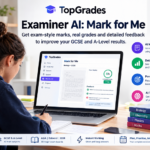
Mark like an examiner. You can upload a paper to receive examiner-style marks, a grade, and feedback in minutes.
Target and track. Every lost mark becomes a focused lesson and quiz, so you can close gaps and watch your predicted grade rise.
Alongside this sits Tia, an AI tutor available whenever you get stuck.
On content coverage, the GCSE hub lists lessons for all three major exam boards: 399 for AQA, 795 for Edexcel, and 603 for OCR. Subject pages are available for GCSE Biology, Chemistry, Physics, and Maths, and the platform states that free lessons, notes, exam-style practice, and instant marking are available. It also says no card is needed to sign up and that there is a free tier forever. Check the pricing page for what paid plans add.
A Revision Routine That Actually Works
A good platform helps, but your routine determines your results. Here is a simple structure you can adapt.
Step 1: Map the course. List every subject and the topics within it. Rate each topic red, amber, or green based on honest confidence.
Step 2: Build a realistic timetable. Work backwards from your exam dates. Aim for short, regular sessions rather than rare marathons, and include breaks and days off.
Step 3: Learn, then test. After studying a topic, close the notes and test yourself with questions. Struggling to recall is not failure. It is how memory strengthens.
Step 4: Revisit on a schedule. Return to topics after a few days, then a couple of weeks, then a month. This spacing is what moves knowledge into long-term memory.
Step 5: Practise under exam conditions. Do timed questions and past papers, then mark them carefully against the mark scheme.
Step 6: Turn mistakes into a plan. Keep a log of lost marks, noting whether each came from a knowledge gap, a misread question, or a careless error. Fix the pattern, not just the question.
Step 7: Protect sleep and wellbeing. Rested students retain more and perform better, so do not trade sleep for extra hours.
Using AI Tools Wisely
AI features such as instant marking and tutoring can speed up feedback, but treat them as one source among several.
- Use AI marking to spot patterns, such as recurring weak topics, then confirm tricky points with your teacher.
- Check against official mark schemes when you can, since marking judgments on extended answers can be subjective.
- Do the thinking first. Attempt questions yourself before asking for help, otherwise you are practising reading answers, not producing them.
- Keep your teacher involved. They know your specification, your school’s expectations, and your individual strengths.
Tips for Parents and Tutors
If you support a student, you can help without taking over. Ask which topics feel weakest, help them keep to a realistic timetable, and encourage regular breaks. Tutors can use a platform’s practice and tracking features to see where a student is losing marks and focus sessions accordingly. TopGrades also lists dedicated sections for tutors and schools on its website.
Final Thoughts
The best revision tool is the one you will actually use consistently, and that gives you honest feedback on where you stand. When comparing GCSE revision websites, look for exam-board-specific content, exam-style practice, quick marking, and a plan that keeps you on track. Combined with a steady routine, strong GCSE revision turns a stressful stretch into a manageable one. You can start free on TopGrades and see whether the approach suits you.
Frequently Asked Questions
1. What makes a good GCSE revision website?Board-specific content, clear lessons, exam-style practice, quick feedback, a study plan, and support when you are stuck.
2. Which exam boards does TopGrades cover?AQA, Edexcel, and OCR, with 399, 795, and 603 lessons listed respectively on the GCSE hub.
3. Is TopGrades free?The site offers free lessons and notes, a free tier, and says no card is needed to start. See the pricing page for paid features.
4. Does TopGrades include A-Level revision?Yes. The platform covers both GCSE and A-Level.
5. Who is Tia?Tia is TopGrades’ AI tutor, available to help when you are stuck on a topic.
6. Can I get my papers marked?According to the site, you can upload a paper for examiner-style marks, a grade, and feedback in minutes. Use it alongside your teacher’s feedback.
7. How often should I revise?Short, regular sessions work best. Space topics out over days and weeks instead of cramming.